The Cellville Chronicles
Story
The Power Plant Workers
May 2026
This is a story about the oldest workers in Cellville. And about the deal they made before Cellville existed.
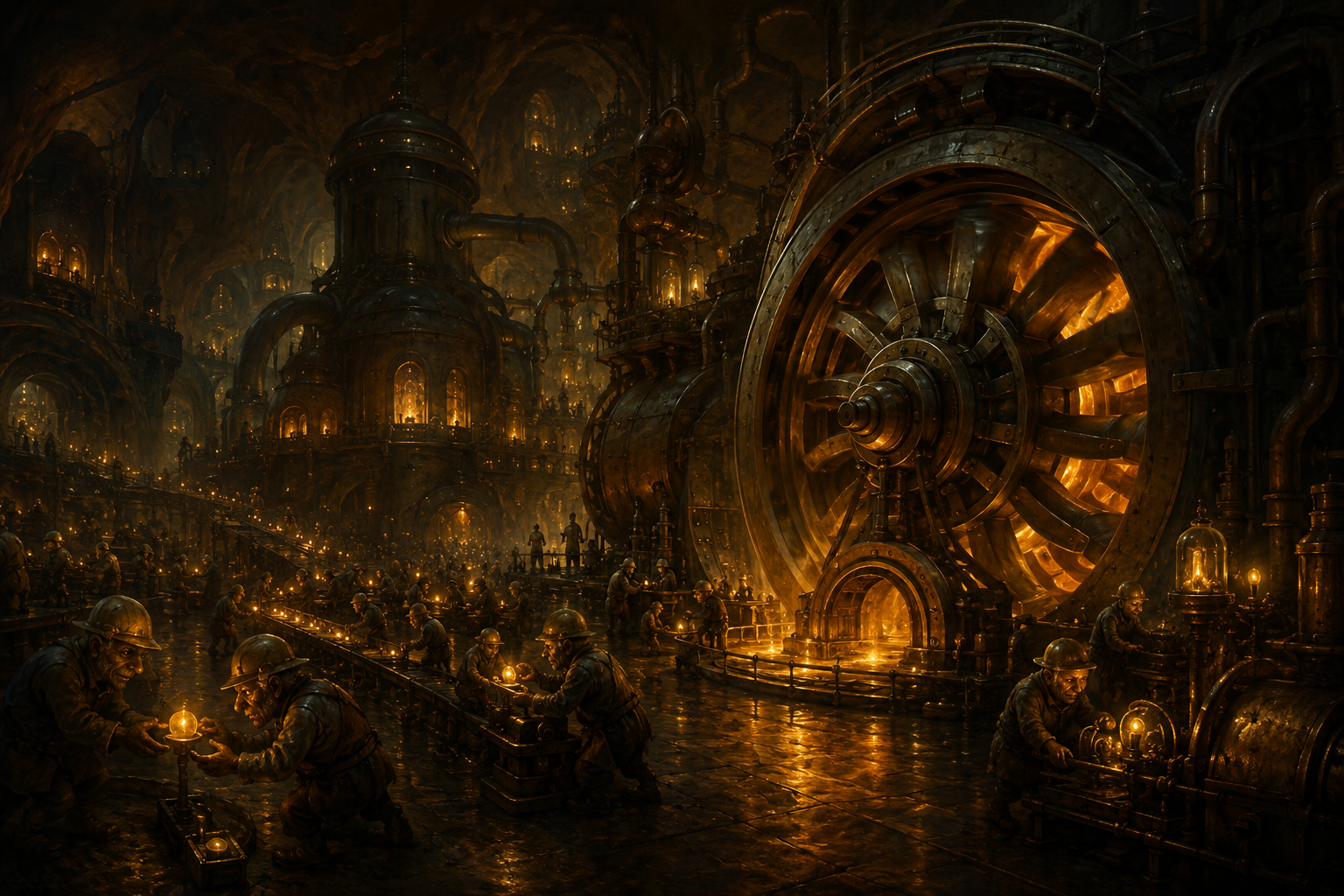
Before Cellville was Cellville, before the giant above had learned to walk or think or eat a sandwich, there were the Workers.
They were not from here. That is the first thing to understand about them. Every other worker in Cellville was born to the kingdom, trained in the kingdom, knew no other home. The Power Plant Workers arrived from somewhere else, in a time so distant that the records do not go back far enough to find it. They were their own kind of creature then. Free. Self-contained. They kept their own records, carried their own instructions, went where they chose.
Then they struck a deal.
Nobody living knows the terms. What is known is the outcome: the Workers came inside and never left. In exchange for shelter and steady fuel, they would run the furnaces. Every furnace, in every department, in every corner of the kingdom. Not some of them. All of them. Forever.
The kingdom agreed. The Workers moved in. That was approximately one and a half billion years ago, and neither party has renegotiated since.
The Furnace Master had been around long enough to remember things others had forgotten, which was not the same as remembering the original deal but was closer than anyone else got. He had a particular respect for the Power Plant Workers that he did not extend to most of the kingdom. It was not warmth exactly. It was the recognition one old professional extends to another.
"They were running furnaces," he said once, to a junior worker who had not asked, "before this kingdom had a name."
The junior worker nodded and moved on. The Furnace Master watched him go, then went back to checking the gauges.
Here is how the Workers ran the furnaces.
Fuel arrived at the plant. Clean coal, since the giant had made the switch, which the Furnace Master approved of because clean coal burned steadily and left fewer sparks than the old wood ever had. The Workers fed it into the line. Each one passed something to the next. Each handoff released a small charge. At the end of the chain, the accumulated pressure pushed through a turbine so small it could not be seen, spinning it with a force that should not have been possible at that scale.
The turbine made ATP.
ATP was the only currency Cellville accepted. You could not spend anything else. You could not borrow it or print it or find it somewhere it had not been made. The Workers made it. Everything else in the kingdom spent it. This was the arrangement and it had worked for one and a half billion years and the Furnace Master saw no reason to expect it to stop.
He did, however, have concerns.
The concerns were about signals.
The Power Plant Workers responded to demand. This was by design and it was sensible: when the kingdom needed more output, more Workers came online, more furnaces ran, more ATP moved through the system. When demand dropped, the opposite happened. Not a firing exactly. More of a thinning. The kingdom stopped building new plants and the old ones quietly aged and the workforce, over time, shrank to match what was being asked of it.
The problem was what was being asked of it.
The giant had grown still. Not in the sudden, alarming way that would have triggered an emergency response, but in the gradual, unremarkable way that looked from the outside like rest and felt from the inside like a life. He sat. He drove. He sat more. He did not labor. He did not push. He did not send the signal that meant: we need more.
The Furnace Master walked the floor of the plants and made his notes. Fewer Workers than last year. Fewer than the year before. The turbines still spinning, but not at the speed he remembered. The giant, up above, would not be able to name what was wrong. He would feel it as dimness. A slowness that was not quite tiredness. The sense that more effort was required to produce what used to come easily.
The Furnace Master wrote it in the log. He had written many things in the log. The log was thorough and accurate and largely unread.
He capped his pen and went back to watching the gauges.
There was a division of Workers that the others regarded with a feeling that had no clean name.
They lived in the cold departments, the ones that activated when the giant's temperature dropped, and they did not do what other Workers did. Other Workers made ATP. These Workers made heat. They took the fuel and instead of running it through the relay and spinning the turbine, they let it burn directly, wastefully, gloriously, like a furnace with the flue wide open.
They were, by any efficiency standard, a disaster.
They were also, in the cold, the most important Workers in the kingdom.
The others called them the Burning Division, which was not an official designation but had stuck. The Burning Division did not mind. They were warm and they knew it and that was sufficient. When the giant stepped into cold water or stood in the morning air without enough layers, the Burning Division came alive in a way that was almost embarrassing to watch. Joyful, even. They had been waiting.
The Furnace Master watched them sometimes. He did not say anything admiring about them because that was not his style. But he did not interfere with them either, which, from the Furnace Master, was as close to praise as anyone got.
The giant, eventually, started moving.
Not dramatically. He did not transform overnight into a different kind of giant. He simply began asking more of the kingdom on a regular basis. He lifted things. He carried things. He sustained effort long enough that the signal went out clearly and could not be mistaken for noise.
The signal reached the plants.
The Furnace Master, checking his gauges on an ordinary morning, noticed the reading had changed. He checked it again. He checked the adjacent gauge. He walked the floor slowly, which was how he always walked the floor, and what he saw was new Workers arriving at the plants. Not a flood of them. A steady increase. The kind that meant the kingdom had received the message and was responding the way it always responded to a clear and consistent signal: carefully, over time, without fanfare.
He updated the log. It was the first update in some time that did not contain a complaint.
New plants came online. The turbines spun faster. ATP moved through the kingdom at a rate the Furnace Master recognized from earlier, better-provisioned times. The giant, up above, noticed only that something had shifted. More output. Less effort to get there. The dimness lifting. The slowness beginning to feel, tentatively, like its old self.
The Power Plant Workers did not mark the occasion. They had been working before the signal arrived and they were working after and the work was the work and that was all.
But there were more of them now.
And they were, in the way of workers who have been doing the same essential job for longer than anyone can remember, exactly where they had always been.
The End.
The moral, if you need one: they gave up everything to live inside you. The least you can do is move.
// author's note
The Power Plant Workers are mitochondria. The ancient deal is real: mitochondria were once free-living bacteria that were absorbed by ancestral cells roughly one and a half billion years ago. They never left. They still carry their own separate DNA, which is why yours comes only from your mother. The relay is the electron transport chain. The turbine is ATP synthase. The currency is ATP and you cannot make it any other way.
The process of building new mitochondria is called biogenesis. The signal that triggers it is exercise, specifically sustained effort over time. There is no pharmaceutical substitute for this signal.
The Burning Division is brown adipose tissue, which is extraordinarily dense in mitochondria and generates heat instead of ATP. Cold exposure activates it.
The dimness the giant felt was real and it had a name: mitochondrial decline. The fix was also real and it had a name: movement. The Workers were always there. They were waiting for a reason to multiply. Give them one.
// The Cellville Chronicles