Optimized Against You
Essay
The Extraction Machine
May 2026
Private equity has been quietly buying the businesses Americans depend on, and the experience of daily life in this country is measurably worse because of it.
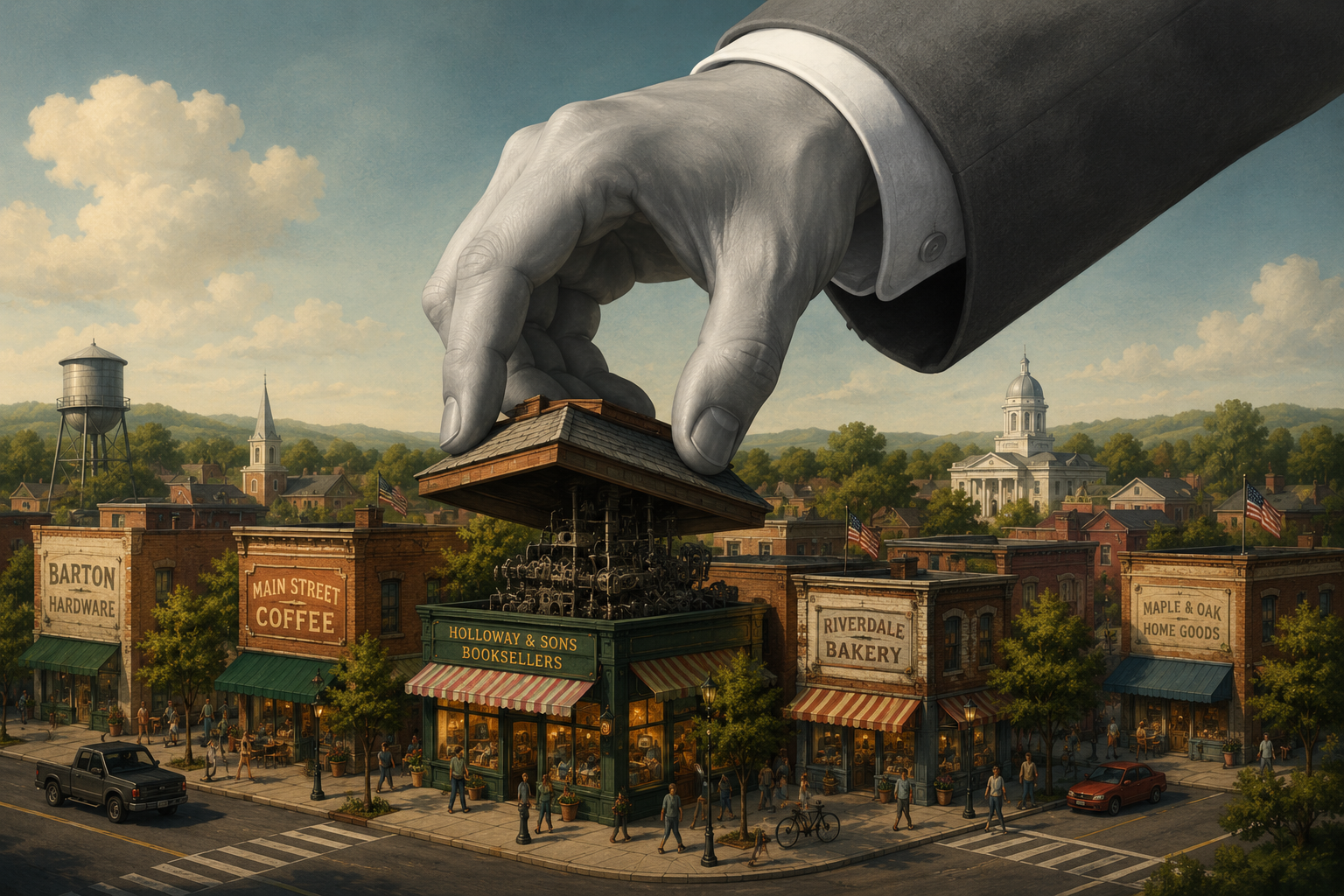
You are sitting in a waiting room that used to feel different. You cannot quite name what changed. The chairs are the same. The receptionist might even be familiar. But the appointment feels rushed, the estimate arrived before the examination was finished, and somewhere in the last eighteen months the place stopped feeling like it was built around you and started feeling like it was built around something else.
It was. You just did not know what.
To understand how, you need to understand one core mechanism: the leveraged buyout. When a private equity firm acquires a company, it typically puts up only about 30 percent of the purchase price in its own money. The other 70 percent is borrowed. Here is the part most people never learn: that debt does not sit on the private equity firm's books. It gets loaded onto the company that was just purchased. The business you used to trust now owes an enormous sum it did not incur, serviced by the cash flows it generates, before a single dollar goes toward improving operations, hiring staff, or maintaining quality.
The firm then has roughly five to seven years to extract enough value from the company to sell it at a profit and exit. That timeline is not a secret. It is the explicit structure of the fund. Everything the company does from the moment of acquisition is oriented toward making it sellable, not toward making it better. You were never part of that calculation.
Private equity is not a new idea. Financier William Simon pioneered the model in the 1970s, buying companies on mostly borrowed funds, extracting large fees, and selling for profit. In the 1980s, greed and debt combined to create what observers called the hottest game on Wall Street, and the industry earned a reputation as the robber barons of the era. It retreated after a wave of failures and bad press, reorganized, rebranded, and came back larger and more systematic than before. Today it operates at a scale that would have been unrecognizable to its founders.
Global private equity deal volume reached approximately two trillion dollars in 2025, the highest since 2021. Firms are currently holding more than 30,000 portfolio companies, nearly half of which were acquired since 2020. These are not abstract financial instruments. They are hospitals, dental practices, veterinary clinics, nursing homes, gyms, restaurants, grocery chains, apartment buildings, and hundreds of other businesses that form the texture of everyday American life.
The sectors that have drawn the most attention are also the ones where the consequences of cost-cutting are hardest to hide.
Healthcare is the clearest example, and the most alarming. Private equity groups now own an estimated 488 United States hospitals along with tens of thousands of physician practices, urgent care centers, addiction clinics, and nursing homes. An estimated 40 percent of hospital emergency departments in the country are staffed or managed by private equity-owned companies. The results are documented in peer-reviewed literature, not just anecdote. Studies published in the Journal of the American Medical Association found that during the two years after a private equity acquisition, total capital assets at acquired hospitals declined by 15 percent on average, while assets rose by 9 percent at other hospitals. Research from the National Bureau of Economic Research found that after a private equity firm buys a nursing home, the facility sees an average reduction in staffing and a decrease in paid hours, with mortality rates increasing by 11 percent.
These are not rounding errors. They are people.
Veterinary care has followed the same trajectory. Independent practices that once operated under a single veterinarian's ownership have been consolidated into national chains through a strategy the industry calls a roll-up. A private equity firm identifies a fragmented market, acquires one practice as a platform, then uses that platform to acquire dozens or hundreds of smaller practices, building scale, centralizing administration, and cutting costs wherever possible, with the goal of selling the consolidated entity at a significant profit before the fund's investment horizon expires. Your vet's name is still on the door. The incentives driving the decisions inside have changed entirely.
Dental care has been similarly transformed. The same roll-up model has produced large corporate dental chains where productivity quotas, not clinical judgment, increasingly drive treatment recommendations. The dentist sees more patients per day than is optimal. The front desk pushes financing options for procedures that a patient in an independently owned practice might not have been told they needed urgently.
Your vet's name is still on the door. The incentives driving the decisions inside have changed entirely.
The list of industries being rolled up extends well past what most people would expect, and that is precisely the point. Private equity looks for fragmented markets with predictable cash flows and no dominant player, which turns out to describe an enormous range of businesses that ordinary Americans use every day without thinking about them as industries at all.
Private equity firms have acquired approximately 800 HVAC, plumbing, and electrical companies since 2022 alone. The plumber your family has called for fifteen years may now be owned by a fund headquartered in a city he has never visited. Workers at some of these acquired companies report feeling pushed more to become salespeople than to do repairs, upselling customers on services they may not need. The incentive structure changed the moment the acquisition closed.
Car washes have become a favorite target. The business model is nearly perfect from a private equity standpoint: low labor requirements, predictable recurring revenue from membership subscriptions, and real estate that can be sold and leased back to generate quick returns. Regional chains have been swept into national platforms, and the membership model that feels like a consumer convenience is also a mechanism for locking in recurring revenue that makes the underlying asset more attractive at exit.
In 2022 alone, there were 19 mergers and acquisitions targeting funeral homes, cemeteries, and crematoria in North America, with a combined value of nearly 900 million dollars. Funeral homes are, from a private equity standpoint, recession-proof businesses with grieving customers who are not in a position to shop around. The moment of maximum vulnerability is also the moment of maximum pricing power, and consolidation reduces the competition that might otherwise constrain it.
Private equity firms have been buying up youth sports facilities, leagues, and tournaments at an accelerating pace. At numerous rinks and sports facilities now under consolidated ownership, parents are no longer allowed to record their own children's games and are instead offered a streaming package that can cost more than a subscription to watch professional sports. The Saturday morning hockey game your kid plays in has been identified as a revenue extraction opportunity.
More than 300 fitness franchise brands have been acquired by private equity firms since 2019, and over 60 percent of the top 20 gym chains in the United States are now backed by private equity. Laundromats, self-storage facilities, and smoothie chains have all seen the same consolidation play. Tattoo studios are beginning to attract roll-up interest, identified as a fragmented market with loyal repeat customers and high margins on a service that people seek out for deeply personal reasons.
The pattern does not vary. Find a market made up of small independent operators. Identify the ones with the most stable cash flows. Acquire, consolidate, centralize administration, cut costs, raise prices where the market will bear it, and prepare for exit. The industry does not matter. The playbook is the same whether the business buries your grandmother, fixes your air conditioner, or floods your eight-year-old's Saturday with upsell opportunities.
Retail has experienced private equity's involvement longest and most visibly. A firm acquires a retailer using borrowed money, loads the company with that debt, sells and leases back the real estate the company owns to generate quick cash, cuts staff and inventory to reduce operating costs, and then sells or takes the company public before the debt burden becomes unmanageable. When it does become unmanageable, the company files for bankruptcy. The private equity firm, having collected its fees and returned capital to its investors, moves on. Private equity takeovers have decimated major retail brands through exactly this process, leaving workers without jobs and communities without anchor stores, while the firms that engineered the outcome reported strong returns.
None of this is illegal. Most of it is not even hidden. The incentive structure of private equity is publicly understood by anyone who looks for it. What is not well understood is how completely that incentive structure has colonized the businesses Americans interact with every day, and how little of that interaction is still governed by the judgment of someone with a long-term stake in the outcome.
The doctor who owned her practice had a reason to maintain her reputation in the community where she lived and worked. The veterinarian who built his clinic from the ground up had a reason to care whether his patients came back. The nursing home administrator who answered to a local board had a different set of pressures than one who answers to a fund manager in a different city whose investors expect an exit in four years.
Costs and risks are shifted to workers, patients, and communities, with understaffing and unsafe conditions appearing in settings where experienced judgment is most critical. That is not an opinion. It is the documented finding of peer-reviewed research published in leading medical journals.
The people running these funds are not villains. They are optimized for a specific outcome within a legal framework that permits it. The limited partners funding the funds, pension funds, university endowments, insurance companies, are themselves optimized for returns that their own obligations require. The system produces this result not because anyone designed it to extract value from sick people and aging parents, but because no one designed it to prevent that from happening either. It was built to serve the people inside it. You were never inside it.
What you can do is limited but it is not nothing. Before your next doctor visit, vet appointment, or gym signup, take two minutes to search who owns the business. Independent ownership is not a guarantee of quality, but it is a signal that someone's long-term reputation is tied to your experience. Seek out independently owned businesses when you can find them and afford them. Support local ownership the same way you would support a local restaurant over a chain: not always, and not at any cost, but with the awareness that the difference is real and that your dollars are one of the few signals the market actually receives.
The businesses Americans grew up trusting were built by people with a long-term stake in what they were building. Many of those businesses still exist. The name is the same. The ownership is not.
// series
Optimized Against You — on the systems inside the food supply, the financial industry, and daily life that were never designed with your biology or your interests in mind, and what to do about it.