Optimized Against You
Essay
The Oil That Isn't
May 2026
The name is the first trick. Vegetable oil. It sounds like something from a garden. That assumption was not an accident. It was engineered.
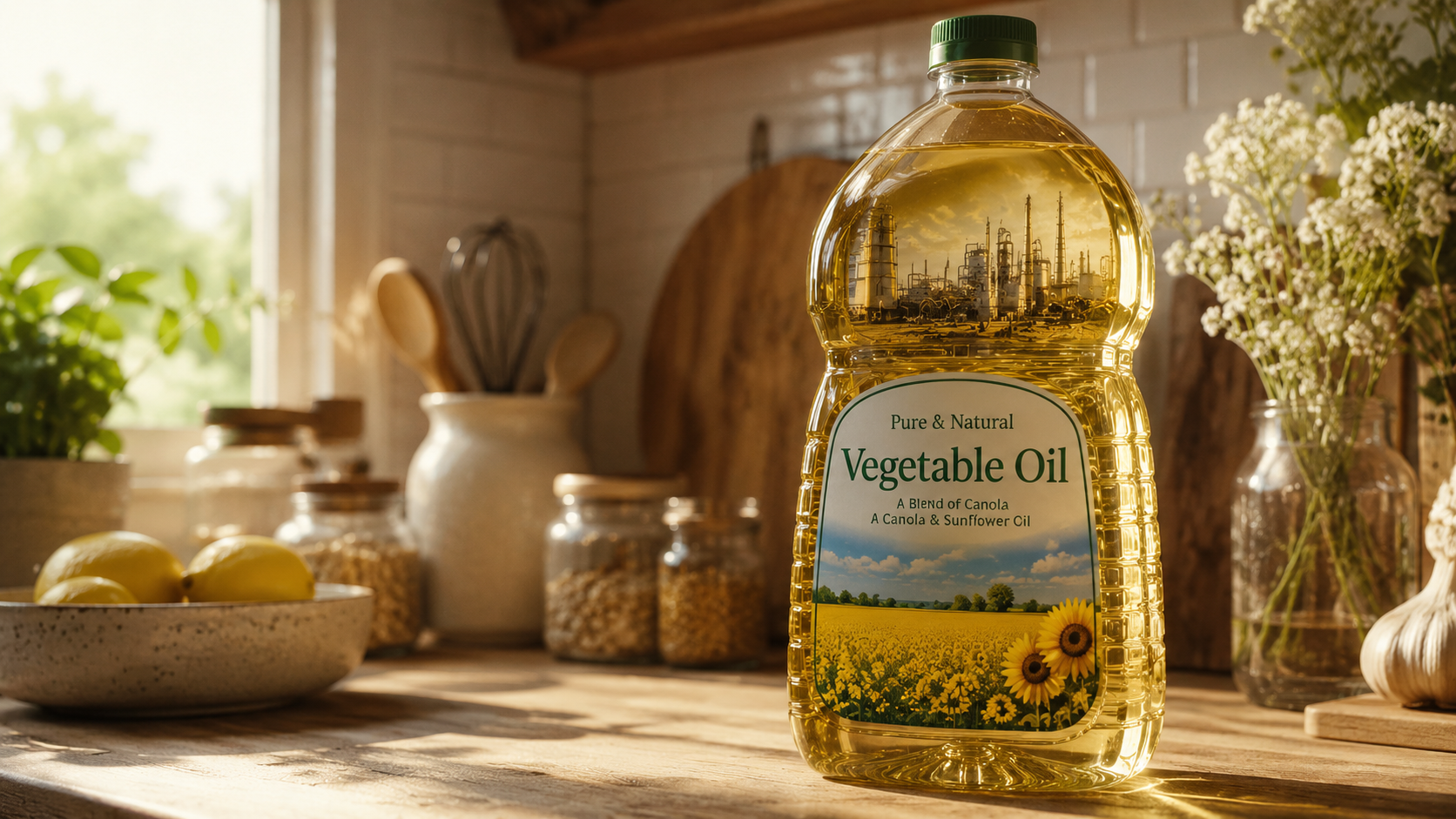
There is a substance in almost every packaged food you own. It is in the restaurant meal you had last week, the salad dressing in your refrigerator, the granola bar you ate because it said "heart healthy" on the front. It has been saturating the American food supply since the 1980s, and before that it was not a meaningful part of the human diet. Not in small amounts. Not in any amounts that mattered.
It is seed oil. And the reason it took over has nothing to do with nutrition.
The name is the first trick. Vegetable oil. It sounds like something from a garden. Vegetables are healthy. Everyone knows that. So vegetable oil must be a healthy way to cook, right? That assumption was not an accident. It was engineered. In the 1970s and 80s, the saturated fats Americans had always cooked with, butter, lard, tallow, came under attack from a campaign rooted in a flawed hypothesis linking dietary fat to heart disease. The food and agricultural industries saw an opportunity. Soybeans and corn were among the most heavily subsidized crops in the country. The oil extracted from those crops was essentially a byproduct, something that would otherwise be waste. With the right lobbying, the right partnerships with government agencies, and the right marketing language, that waste product became the centerpiece of American nutritional guidance. The USDA food pyramid enshrined it. The American Heart Association endorsed it. Doctors repeated it. And Americans, reasonably trusting the institutions around them, believed it.
What they were sold is not something humans had eaten in any meaningful quantity before.
Getting oil out of a soybean is not like pressing an olive or churning butter. The fat is locked inside a structure that does not give it up easily. To extract it at industrial scale, manufacturers use a chemical solvent called hexane, a component of gasoline, to dissolve the oil out of the crushed seed material. The hexane is then boiled off. Most of it. The remainder is considered acceptable by regulatory standards, which is its own sentence worth sitting with.
The raw extracted oil looks dark and smells terrible. So it gets degummed, refined, bleached, and deodorized. Four separate industrial processes. High heat is applied at multiple stages, degrading the oil before it ever reaches a shelf. The final product is clear, odorless, and shelf-stable. It is also something humans are now consuming in quantities and concentrations that have no precedent in the history of the species.
Now here is what happens once it is inside you.
Seed oils are almost entirely composed of a fatty acid called linoleic acid, a type of omega-6 fat. Omega-6 is not inherently bad. Your body needs some of it. The problem is the ratio. For most of human history, people consumed omega-6 and omega-3 fats in roughly equal amounts, maybe two to one at the outside. Today the average American consumes them at a ratio closer to twenty to one in favor of omega-6. That imbalance matters because these two types of fat compete for the same metabolic pathways. When one overwhelms the other, the balance of signals your body uses to regulate inflammation, immune response, and cellular repair shifts in ways that researchers are still working to fully understand.
The more defensible concern, and the one hardest to argue with, is what happens to linoleic acid under heat.
Linoleic acid is chemically unstable. It oxidizes when exposed to heat, light, or air. Cooking with seed oils, especially at high heat, produces a cascade of degradation products: aldehydes, lipid peroxides, and other reactive compounds that damage cells, impair mitochondrial function, and promote oxidative stress. This is not a fringe concern, particularly in the context of repeatedly heated commercial fryer oil. Gas chromatography studies of used restaurant fryer oil show aldehyde concentrations at levels that would be considered hazardous in an industrial setting. Every basket of fries, every stir-fry in a commercial kitchen, every chip fried at scale is cooked in oil that has been heated repeatedly and is producing these compounds continuously.
Saturated fats, butter, tallow, lard, coconut oil, are significantly more stable under heat. Their chemical structure resists the oxidation process that makes seed oils degrade. Our ancestors cooked in these fats for thousands of years. The idea that they are dangerous and industrially refined seed oils are a healthy replacement is one of the most consequential nutritional reversals in modern history, driven as much by agricultural economics and industrial scalability as by nutritional science.
Look at the obesity rate in the United States from 1960 to today. It runs essentially flat through the 1970s. Then, beginning around 1980, it begins climbing. It does not stop. By the early 2000s it has doubled. By 2020 it has nearly tripled. Many things changed around 1980. Sugar consumption surged. Processed food exploded. Physical activity declined. Seed oils were not the only variable. But they were woven into nearly every part of what changed, because cheap industrial oils are the fat of the processed food system. You cannot separate them from the transformation. The timeline is not subtle, and the biology gives you more than enough reason to take it seriously.
The timeline is not subtle, and the biology gives you more than enough reason to take it seriously.
When you eat at a restaurant, nearly every dish was cooked in soybean or canola oil. When you buy packaged food, seed oils appear in crackers, bread, protein bars, frozen meals, salad dressings, mayonnaise, chips, and most things labeled low-fat or heart-healthy. They are the default fat of the processed food industry because they are extraordinarily cheap and have a long shelf life. Your biology was not part of that calculation.
The food companies are not malicious. They are optimized for cost, shelf life, and regulatory compliance. Seed oils clear every regulatory bar. The FDA considers them safe. The American Heart Association still recommends them over saturated fat, a position rooted in older nutritional frameworks that remain actively debated. None of this creates an incentive to change. The incentive runs the other direction. Butter costs more. Tallow requires sourcing. Consumers who do not know the difference will not pay for the difference. And most consumers do not know the difference, because nothing in the system around them is designed to help them know.
You can fix this. Cook at home with butter, ghee, tallow, lard, or coconut oil. When you buy packaged food, read the ingredients. Avoid anything that lists soybean oil, canola oil, vegetable oil, corn oil, sunflower oil, safflower oil, cottonseed oil, or grapeseed oil. When you eat out, you will be exposed to seed oils and there is not much you can do about that except reduce how often it happens.
The oils used for most of human history were never the problem. They were replaced by something cheaper, marketed as an upgrade by the businesses that stood to profit, blessed by the government agencies those businesses influenced, and repeated by doctors who trusted the guidelines they were handed.
The label says vegetable oil. It sounds like something from a garden. It isn't.
// series
Optimized Against You — on the systems inside the food supply, the financial industry, and daily life that were never designed with your biology or your interests in mind, and what to do about it.