Optimized Against You
Essay
What the Label Doesn't Say
May 2026
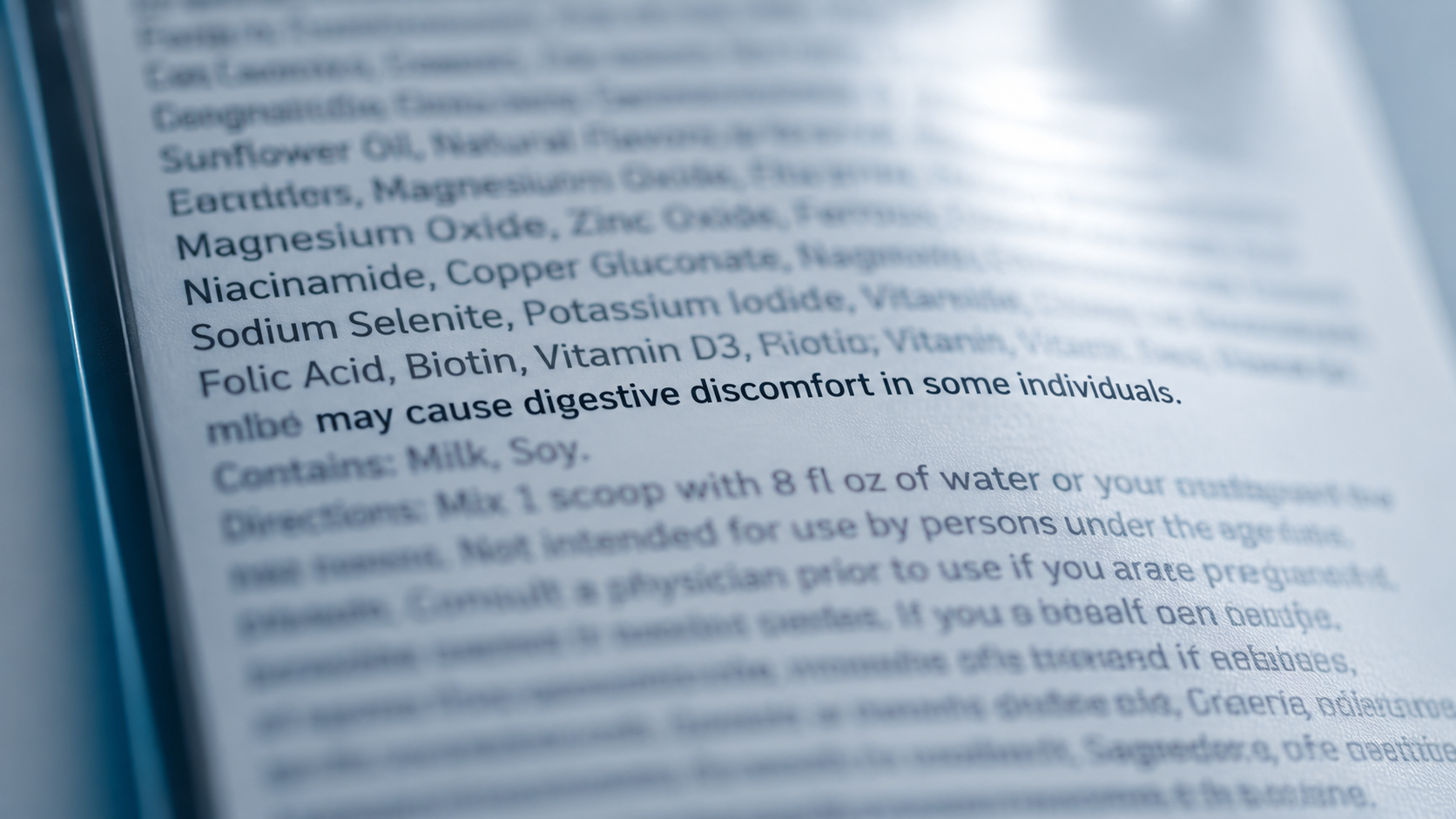
The label says "may cause digestive discomfort in some individuals." What it doesn't say is that this ingredient is actively working against your body's ability to absorb the minerals it needs to function.
I built a precise electrolyte system from scratch.
Not because I wanted a project. Because I was waking up with leg cramps. That matters more than it sounds. I rarely get leg cramps. In fact I almost never get them. When they started occurring with some consistency, waking me at 5am with my calves seizing, I knew something specific was wrong. Not a vague sense of being off. A specific, correctable problem. The symptom was telling me something and I intended to find out what.
I researched the mechanism behind keto and sodium depletion. I sourced every ingredient individually: magnesium glycinate, potassium chloride, trace minerals, zinc. I understood exactly what I was putting in my body and why. I fixed the sodium. I built the system. I did everything right.
And I still woke up at 5am with my calves seizing.
I was also losing my train of thought mid-sentence and running out of energy by mid-afternoon. Those symptoms had improved when I addressed the sodium. But the cramps persisted. Something else was still wrong.
When a precise system produces unexpected results, the variable you haven't examined is usually the answer. I went back through everything methodically. Sodium addressed. Magnesium in the mix. Hydration at three liters daily. Sleep solid. Nothing obvious was missing.
Then I looked at the gum.
I'd been chewing a pack a day. Extra. Orbit. Trident. The slim boxes that have been sitting in gas station checkout lanes for decades, right next to the register, priced at impulse-buy levels, available everywhere food is sold and in most places it isn't. I'd been chewing it for years without a second thought. It's gum. It's not food. It doesn't count.
Except it does.
These gums are sweetened with sorbitol. Sorbitol is a sugar alcohol, and sugar alcohols are not absorbed by the small intestine the way regular sugars are. Instead they travel intact into the large intestine where they act as osmotic agents, drawing water across the intestinal wall and accelerating transit time. This is why prunes work. This is why certain protein bars come with a quiet warning about excessive consumption. This is why sorbitol in high enough doses is sold as a laxative.
Sorbitol is not alone. It belongs to a category of ingredients called sugar alcohols that all operate on the same mechanism to varying degrees. Xylitol, maltitol, erythritol, mannitol. They are in protein bars, sugar-free candy, chewable vitamins, certain protein powders, and a hundred other products marketed as clean, healthy, and guilt-free. You probably have some in your cabinet right now. Sugar-free gummy bears. Altoids Smalls. Many Quest bars. Most chewable vitamins. Virtually every product labeled diabetic-friendly. The label says sugar-free. Your brain reads healthy. The biology doesn't care what your brain reads. Sorbitol is simply the most potent offender in the category, which is why it showed up first. But if you are sensitive enough to feel sorbitol's effects, the rest of the category deserves scrutiny too.
A pack of Extra contains roughly 20 grams of sorbitol. The threshold where most people experience measurable GI effects is 10 to 20 grams daily.
I was at the ceiling every single day.
But here's what the label doesn't say, and what "may cause digestive discomfort in some individuals" catastrophically fails to communicate: sorbitol doesn't just give you a stomach ache. It actively strips your body of what it needs to function. When sorbitol pulls water across the intestinal wall, it doesn't pull water alone. It accelerates the movement of everything in your gut, including the minerals you just carefully consumed. Magnesium. Potassium. Sodium. The electrolytes I was measuring and drinking every day were being swept through my system before absorption could occur. Not some of them. Not occasionally. Every day, at every meal, consistently and invisibly, the gum was undoing the work of the protocol.
I wasn't just getting a digestive side effect. I was running a slow drain on the entire system I was trying to build. One piece of gum at a time. Sixteen hours a day. With a cheerful spearmint flavor.
The electrolytes I was measuring and drinking every day were being swept through my system before absorption could occur. Consistently and invisibly, the gum was undoing the work of the protocol.
This information exists. It lives in gastroenterology journals and clinical nutrition literature. Doctors who treat IBS know it. The FDA knows it. Sorbitol is classified as Generally Recognized As Safe, which from a regulatory standpoint ends the conversation.
What it doesn't do is end up on the label in any form that would actually change your behavior.
"May cause digestive discomfort in some individuals" is the kind of language that was written by a lawyer, approved by a regulatory affairs team, and designed to communicate the minimum required truth while implying the maximum possible safety. It sounds like a stomach ache. It sounds manageable. It sounds like a personal sensitivity issue that probably won't affect you.
It does not sound like: this ingredient is actively working against your body's ability to absorb the minerals it needs to function. It does not sound like: if you are carefully managing your nutrition, this product is quietly dismantling that effort in the background. It does not sound like any of the things that are actually true.
Those are not the same statement. But only one of them is on the box.
This isn't really about gum.
It's about the gap between what a label implies and what's actually happening inside your body. That gap is where a lot of chronic unexplained suffering lives. The fatigue that doesn't respond to sleep. The brain fog that persists despite clean eating. The muscle cramps that continue despite doing everything right. Symptoms that accumulate quietly and get attributed to stress, aging, or personal constitution rather than to something specific and fixable hiding in plain sight.
The products responsible for that gap are not malicious. They are optimized. Optimized for shelf stability, manufacturing cost, regulatory compliance, and liability management. Your biology is not part of that optimization. It never was. The system is not conspiring against you. It simply was never designed with you in mind. There is no villain. There is only a set of incentives that does not include your best interests, and a label that reflects those incentives perfectly.
I only found this because I was operating at a level of precision that made the interference visible.
I had built something specific enough that an unexpected result couldn't hide. When your system is vague, eat better, drink more water, take a multivitamin, there's nowhere for anomalies to surface. Everything becomes background noise. But when you know exactly what you're putting in your body and exactly what it should be doing, a variable that doesn't belong becomes visible.
Most people never get there. Not because they aren't capable. Because nothing in the system around them is designed to help them get there. The label says safe. The doctor says fine. The gas station sells it at eye level next to the register. And the drain runs quietly in the background, day after day, while you wonder why you still feel off.
So here is the practical thing you can do right now. Flip over anything in your cabinet that is sugar-free, reduced sugar, or diabetic-friendly. Look for these words in the ingredients: sorbitol, xylitol, maltitol, erythritol, mannitol. If you find them, you have found a potential drain. How much of it you consume daily determines how much it matters. But now you know what to look for. The label won't tell you. It never will.
I was being systematically drained by something I trusted, bought without thinking, and never thought to question. The label said nothing useful. My body said everything. The system had a drain. I found it. That's the whole story. The only thing required was enough precision to see it.
// series
Optimized Against You — on the systems inside the food supply that were never designed with your biology in mind, and what to do about it.